dog
The dogs of Animal Farm begin as ordinary working animals, but under Napoleon's calculated manipulation they are transformed into a private guard force that enforces his tyranny through violence and intimidation, becoming the primary instrument of political repression on the farm. Their evolution from playful puppies to brutal enforcers marks the central turning point in the farm's descent from revolutionary idealism into autocratic rule.
Identity and Early Role
At the outset, the dogs are unremarkable members of the farm community. Three adult dogs—Bluebell, Jessie, and Pincher—are present at Old Major's speech, where they sit among the other animals and listen to the call for rebellion. During the vote on whether rats should be considered comrades, the three dogs are among the four dissenters, alongside the cat, who is later discovered to have voted on both sides. This early dissent hints at a certain exclusivity, but at this stage the dogs hold no special status. They are simply part of the animal collective, no more powerful or privileged than the pigs, horses, or sheep.
The Puppies and Their Secret Education
The decisive change begins soon after the Rebellion. Jessie and Bluebell both whelp soon after the hay harvest, giving birth between them to nine sturdy puppies. As soon as they are weaned, Napoleon takes the puppies away from their mothers, saying he will make himself responsible for their education. He sequesters them in a loft that can only be reached by a ladder from the harness-room, keeping them in such seclusion that the rest of the farm soon forgets their existence. This secret rearing is the first clear sign that Napoleon is planning something beyond the ordinary management of the farm. The puppies are not being trained for farm work; they are being prepared for a specific purpose that Napoleon has not disclosed to anyone.
The Expulsion of Snowball and the Dogs' Emergence as Enforcers
The dogs' true purpose is revealed at the critical moment when Snowball is about to win the vote on the windmill. Just as Snowball's eloquence has carried the animals away, Napoleon stands up and utters a high-pitched whimper of a kind no one has ever heard from him before. At this signal, a terrible baying sound comes from outside, and nine enormous dogs wearing brass-studded collars come bounding into the barn. They dash straight for Snowball, who only just escapes their snapping jaws by slipping through a hole in the hedge. The dogs are the puppies Napoleon has reared privately; though not yet full-grown, they are huge and as fierce-looking as wolves. They keep close to Napoleon, and it is noticed that they wag their tails to him in the same way the other dogs had been used to do to Mr. Jones. This gesture—the tail-wag of submission and loyalty—makes explicit that the dogs' allegiance has been transferred from the human master to the pig who now occupies his place.
Immediately after Snowball's expulsion, Napoleon mounts the raised platform where Old Major had once stood and announces that the Sunday-morning Meetings are abolished. When four young porkers in the front row utter shrill squeals of disapproval and spring to their feet to protest, the dogs sitting around Napoleon let out deep, menacing growls, and the pigs fall silent and sit down again. The dogs do not need to attack; the threat of their violence is enough to suppress dissent. From this moment onward, the dogs function as Napoleon's personal bodyguard and the farm's internal police force, their mere presence sufficient to enforce obedience.
The Dogs as Instruments of Terror and Execution
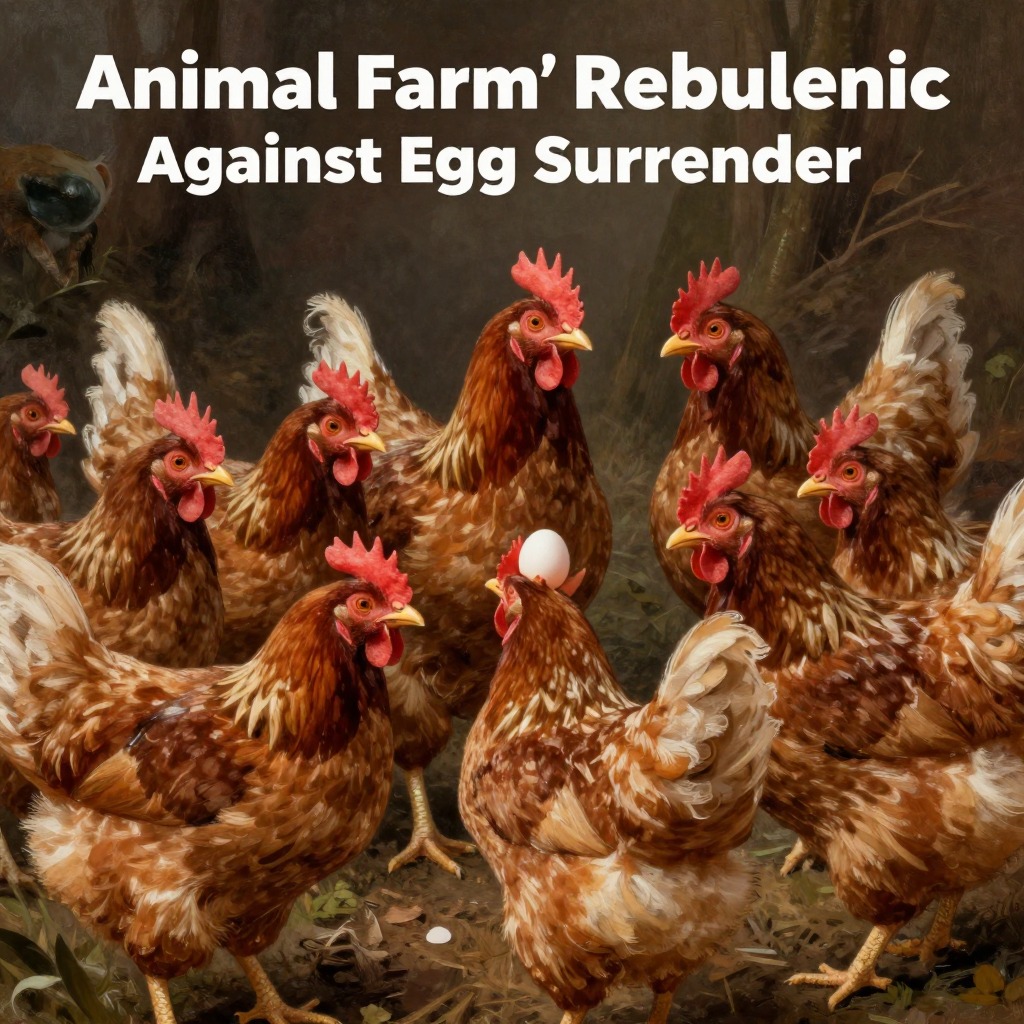
Throughout the rest of the novel, the dogs are deployed systematically to crush any opposition. When the hens rebel against the order to surrender their eggs, Napoleon orders their rations stopped and decrees that any animal giving so much as a grain of corn to a hen shall be punished by death; the dogs see to it that these orders are carried out. Nine hens die during the five-day standoff, and their bodies are buried in the orchard, with the official story being that they died of coccidiosis.
The most brutal use of the dogs occurs during the Purge. Napoleon emerges from the farmhouse wearing both his medals, with his nine huge dogs frisking round him and uttering growls that send shivers down all the animals' spines. He utters a high-pitched whimper, and immediately the dogs bound forward, seize four pigs by the ear, and drag them squealing to Napoleon's feet. The pigs' ears are bleeding; the dogs have tasted blood, and for a few moments they appear to go quite mad. Three of the dogs even fling themselves upon Boxer, but Boxer catches one in mid-air and pins it to the ground; Napoleon orders the dog released, and it slinks away bruised and howling. After the four pigs confess to being in league with Snowball, the dogs promptly tear their throats out. Then, one by one, the hens who led the egg rebellion, a goose who confessed to stealing corn, and three sheep who confessed to various crimes are all slain on the spot by the dogs. The pile of corpses grows before Napoleon's feet, and the air becomes heavy with the smell of blood—a smell unknown on the farm since the expulsion of Jones.
The Dogs' Privileged Position and Final Role
As the farm becomes more stratified, the dogs share in the pigs' privileges. Their rations are never reduced when other animals face shortages; Squealer explains that a too rigid equality in rations would be contrary to the principles of Animalism. The dogs do not produce any food by their own labour, but there are very many of them, and their appetites are always good. They are fed dog biscuits, which must be purchased from outside, adding to the farm's expenses. By the end of the novel, the dogs are part of the ruling class, their ferocity ensuring that no animal dares to protest the pigs' ever-increasing power.
In the final scene, when the pigs emerge walking on their hind legs, Napoleon himself appears with his dogs gambolling round him, carrying a whip in his trotter. The dogs are now the visible guardians of a regime that has completely betrayed the principles of the Rebellion. They have come full circle: from ordinary farm animals to the private army of a dictator, their loyalty transferred from one master to another, their violence the ultimate guarantee that the pigs' rule will not be challenged.